We all know the basic fruit family that we see in the supermarket - apples, pears, oranges etc. Some of us partake in some more exotic fruits. But there are some fruits you may have never seen in your ordinary supermarket. Many of these can be found in specilizied fruit and vegetables stores, while others you won't find outside their home countries (many of which are in South America).
These are delicious fruits that are just as tasty and just as healthy to eat as any fruit you've had so far, so let's get to know them:
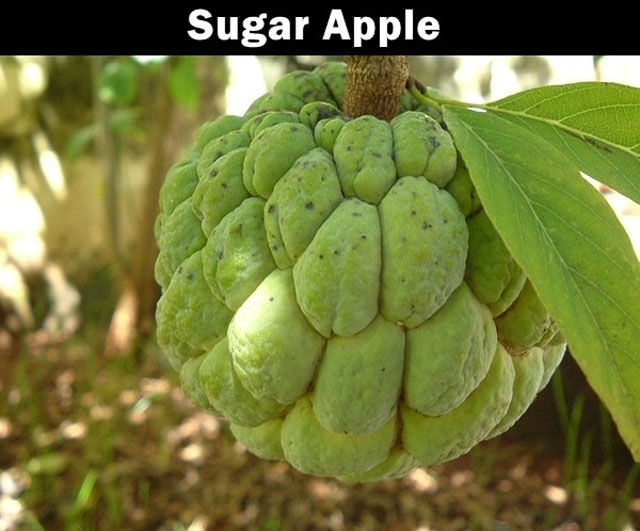
The fruit is round to conical, 5–10 cm (2.0–3.9 in) in diameter and 6–10 cm (2.4–3.9 in) long, and weighing 100–240 g (3.5–8.5 oz), with a thick rind comprised of knobby segments. The color is typically pale green to blue-green, with a deep pink blush in certain varieties, and typically has a bloom. It is unique among Annona fruits in being segmented, and the segments tend to separate when ripe, exposing the interior.
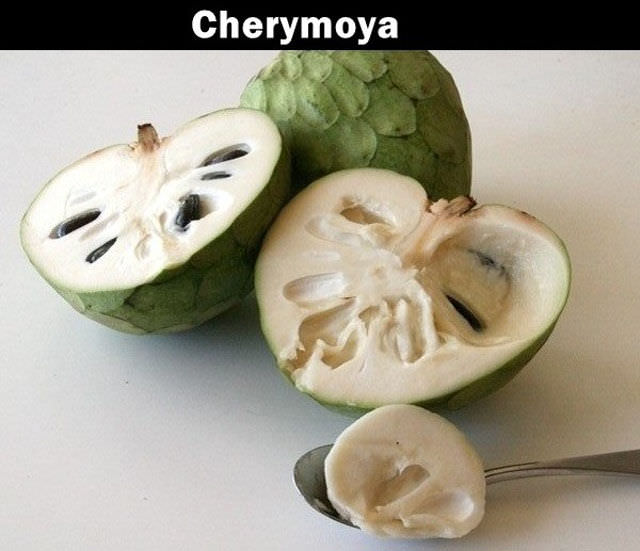
The flesh is fragrant and sweet, creamy white to light yellow, and resembles and tastes custard. It is found adhering to 13–16 mm (0.51–0.63 in) long seeds to form individual segments arranged in a single layer around the conical core. It is soft, slightly grainy, and slippery. The hard, shiny seeds may number 20-38 or more per fruit, and have a brown to black coat, although varieties exist that are almost seedless.
Mark Twain called the cherimoya "the most delicious fruit known to men." The fruit is fleshy and soft, sweet, white in color, with a sherbet- texture, which gives it its secondary name, custard apple. Some characterize the flavor as a blend of banana, pineapple, papaya, peach, and strawberry. Others describe it as tasting commercial bubblegum.
Similar in size to a grapefruit, it has large, glossy, dark seeds that are easily removed. When ripe, the skin is green and gives slightly to pressure, similar to the avocado. Many people often chill the cherimoya and eat it with a spoon, which has earned it another nickname; the ice cream fruit.
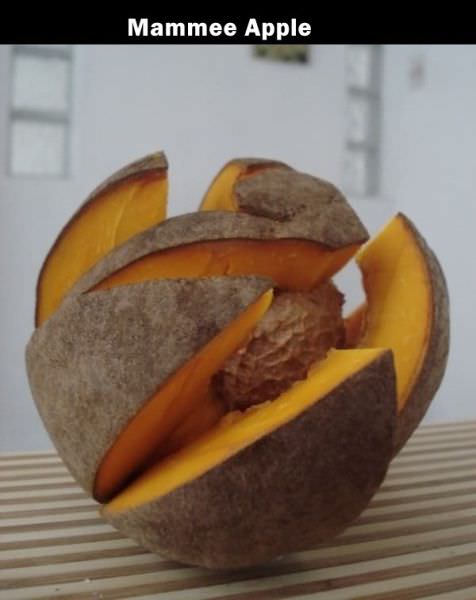
It is round or slightly irregular, with a brown or grey-brown 3 mm (0.12 in) thick rind. In fact, the rind consists of the exocarp and mesocarp of the fruit, while the pulp is formed from the endocarp. The stem is thick and short. The mammee apple has more or less visible floral remnant at the apex. Mammee apples' diameter ranges from 10 cm (3.9 in) to 20 cm (7.9 in). When unripe, the fruit is hard and heavy, but its flesh slightly softens when fully ripe.
Beneath the skin, there is a white, dry membrane, whose taste is astringent, that adheres to the flesh. The flesh is orange or yellow, not fibrous, and can have various textures (crispy or juicy, firm or tender). Generally, the flesh smell is pleasant and appetizing. Small fruits contain a single seed, while larger ones might have up to four. The seeds are brown, rough, oval and around 6 cm (2.4 in) long. The juice of the seed leaves an indelible stain.
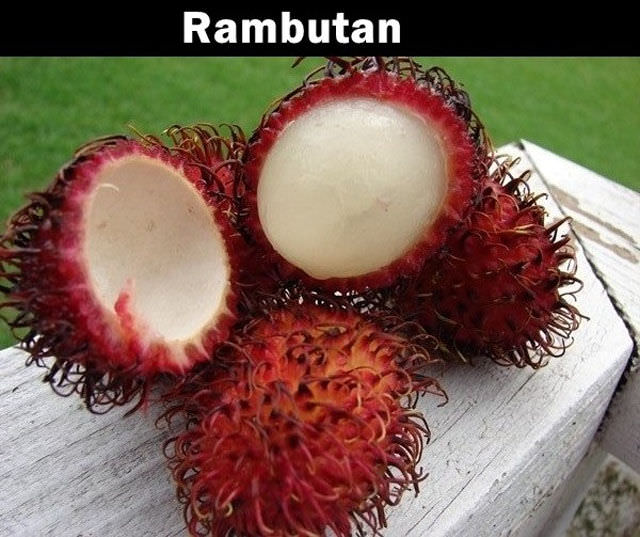
The fruit is a round to oval drupe 3–6 cm (rarely to 8 cm) tall and 3–4 cm broad, borne in a loose pendant cluster of 10–20 together. The leathery skin is reddish (rarely orange or yellow), and covered with fleshy pliable spines, hence the name rambutan, derived from the Malay word rambut, which means hairs. The fruit flesh is translucent, whitish or very pale pink, with a sweet, mildly acidic flavor very reminiscent of grapes. The single seed is glossy brown, 1–1.3 cm, with a white basal scar.
Soft and crunchy, the seeds may be cooked and eaten. Some folklore regards the seeds as poisonous, but tests of seed extracts reveal no toxicity to mice, even in doses up to 2500 mg/kg. The extract does show some analgesic activity, however. The peeled fruits can be cooked and eaten, first the grape- aril, then the nutty seed, with no waste.
RSS
عضو شوید
عضویت سریع
آمار مطالب
آمار کاربران
کاربران آنلاین
آمار بازدید










 عضو شوید
 عضویت سریع
 آمار مطالب
 آمار بازدید